Learn Python Programming
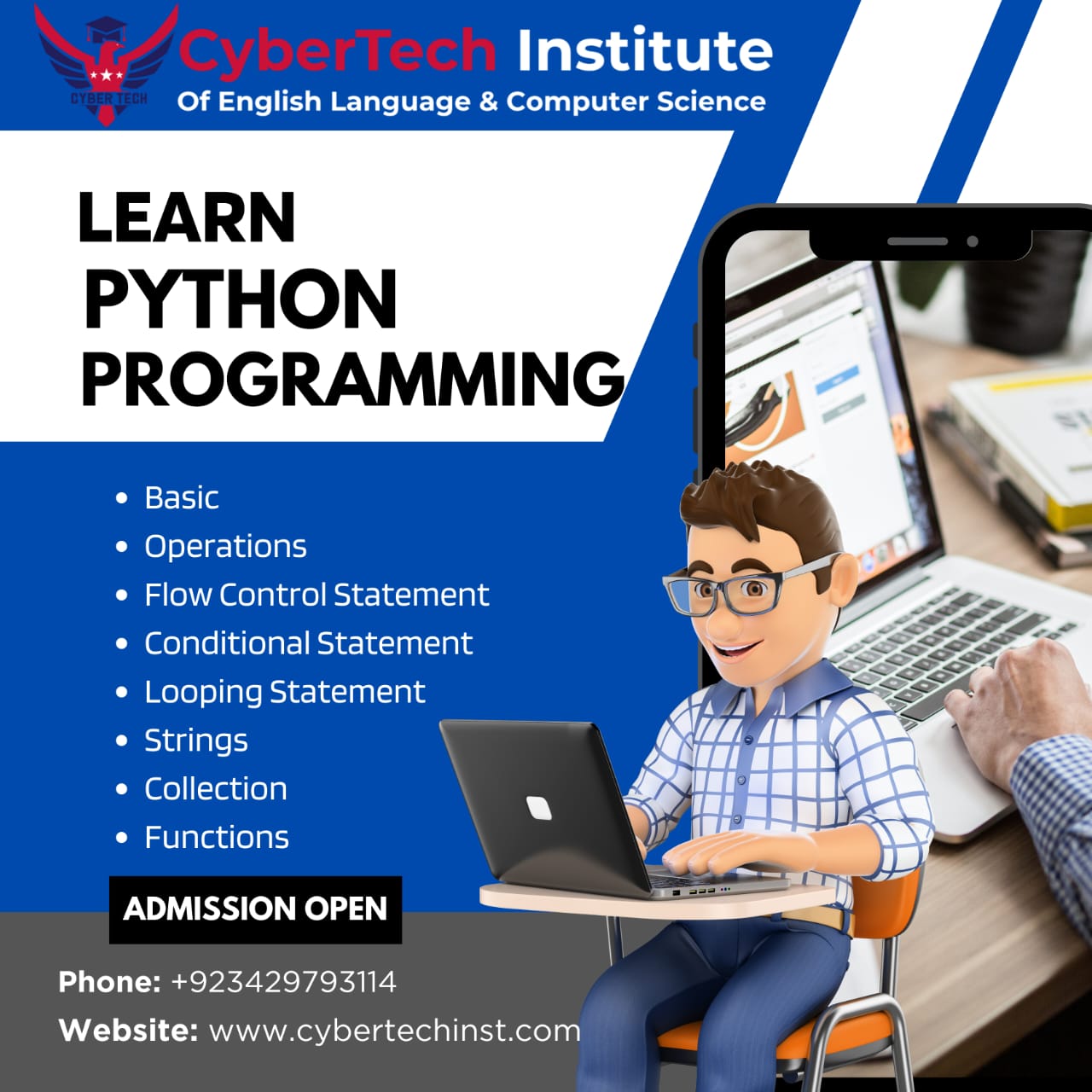
About Course
🐍 CyberTech Institute: Master Python Programming Your Gateway to the Digital Future 🚀
[CyberTech Institute of English Language & Computer Science]
In today’s fast-paced digital era, Python Programming stands out as the essential skill that can launch or elevate your career to new heights. Its simplicity, versatility, and staggering industry demand make it the ideal choice for every aspiring developer and professional. CyberTech Institute is here to equip you with this powerful skill set.
In this comprehensive guide, we present a detailed breakdown of the Python Programming Course offered by CyberTech Institute. We will explore every module specified in our course structure, from Basic fundamentals to advanced Functions, ensuring you understand the depth and breadth of the knowledge you will gain.
1. Building the Foundation: Basic Fundamentals
Every great structure requires a strong foundation. Our course starts right at the core, ensuring you build a robust and clear understanding of Python’s essentials.
A. Introduction to Python and Environment Setup
We begin by introducing Python what it is, its philosophy of readability, and why it is the language of choice across fields like Data Science, Web Development, and AI. This quickly moves into the practical setup phase:
- Installation: Guiding you through installing the Python interpreter and Pip (the package installer) on your operating system.
- IDE Setup: Setting up a powerful Integrated Development Environment (IDE) like VS Code or PyCharm, optimizing your coding workflow with features like syntax highlighting and debugging.
B. Variables and Data Types
Learning how to store and manage information is paramount in programming.
- Variables: Understanding how to declare, assign, and properly name variables according to PEP 8 conventions for writing clean, readable Python code.
- Fundamental Data Types: A deep dive into Python’s built-in data types:
- int: Handling whole numbers for counting and arithmetic.
- float: Managing decimal numbers for precise calculations.
- str: Working with textual data, essential for almost all applications.
- bool: The core of logic, representing True or False states.
- Type Conversion: Techniques for safely converting data from one type to another (e.g., string to integer) using functions like int(), float(), and str().
C. Basic Input and Output
The fundamental tools for interacting with the user and displaying results.
- The print() Function: Mastering the use of the print() function for output, including controlling separators (sep) and line endings (end).
- The input() Function: Collecting data from the user during program execution, understanding that it always returns data as a string and requires subsequent type conversion.
2. Manipulating Data: Operations
Operations are the actions performed on data. Proficiency in these operators allows you to execute complex calculations and make logical comparisons.
A. Arithmetic Operators
The tools for mathematical processing:
- Standard Operators: Addition ($+$), Subtraction ($-$), Multiplication ($*$), and Division ($/$).
- Integer Division ($//$): Performing division that discards the fractional part, returning an integer result.
- Modulo ($\%$): Finding the remainder of a division, a crucial operation for checking parity (even/odd) and cyclic behavior.
- Exponentiation ($$):** Calculating powers.
We place heavy emphasis on Operator Precedence (Order of Operations) to ensure accurate code execution.
B. Assignment Operators
Shorthand ways to update the value of a variable:
- Simple Assignment (=): Assigning a value.
- Compound Assignment (+=, -=, *= etc.): Combining an arithmetic operation and assignment into a single, concise statement (e.g., x += 5 is equivalent to x = x + 5).
C. Comparison Operators
These operators compare two values and always return a Boolean result (True or False):
- Equality Checks: == (Equal to) and $!=$ (Not Equal to).
- Relational Checks: $>$ (Greater than), $<$ (Less than), $>=$ (Greater than or Equal to), $<=$ (Less than or Equal to).
These are the building blocks of all Conditional Statements.
D. Logical Operators
Used to combine or modify Boolean expressions for complex decision-making:
- and: Returns True if both operands are true.
- or: Returns True if at least one operand is true.
- not: Reverses the logical state.
We explore Boolean Algebra and Truth Tables to solidify the understanding of complex logical chains.
3. Directing the Execution: Flow Control Statement
Flow control defines the order in which individual statements or instructions are executed. It is the mechanism that moves a program beyond simple, sequential execution.
A. Understanding Execution Path
We explain how, by default, a program executes instructions sequentially, one after the other, and how flow control statements interrupt and modify this default path.
B. Categorizing Control Flow
The two primary ways to control flow:
- Conditional Execution: Making a decision to execute a block of code based on a condition (Decision Making).
- Iterative Execution: Repeating a block of code multiple times (Repetition or Looping).
C. The Significance of Indentation
In Python, indentation is mandatory and defines code blocks. We stress the importance of using a consistent four spaces for indentation, as it directly dictates the scope and structure of your flow control statements.
4. Making Choices: Conditioal Statement
Conditional statements are the decision-making engine of a program, allowing the code to choose which path to follow based on whether a condition is met.
A. The Simple if Statement
The most basic decision structure: if the condition is True, execute the indented code block; otherwise, skip it. We use examples like input validation to demonstrate its function.
B. The if-else Statement
Handling two possible outcomes. If the condition is True, the if block runs. If the condition is False, the else block runs. This ensures that the program always takes one of two defined actions.
C. The if-elif-else Ladder
The structure for handling multiple, mutually exclusive conditions. The elif (else if) statement allows the program to check a series of conditions and execute the block corresponding to the first one that evaluates to True.
- Practical Example: Implementing a complex grading system or a multi-level access control system.
D. Ternary Conditional Expressions
Learning the concise, single-line way to write simple if-else expressions, improving code readability for short checks (e.g., result = “Pass” if score >= 50 else “Fail”).
E. Nested Conditional Structures
Writing an if statement inside another if or else block to handle complex, dependent conditions (e.g., checking if a user is logged in AND if they have administrator privileges).
5. Repeating Actions: Looping Statement
Loops are crucial for automation, efficiency, and iterating over collections of data. They allow a program to perform repetitive tasks without redundant code.
A. The for Loop
Ideal for definite iteration looping over a known sequence or for a fixed number of times.
- Iteration over Sequences: Using for to easily access every item in a list, string, or tuple.
- Using range(): Mastering the range(start, stop, step) function to generate sequences of numbers and control the exact number of loop repetitions.
B. The while Loop
Ideal for indefinite iteration running a block of code as long as a specified condition remains True.
- Condition-Based Execution: Implementing scenarios like user login attempts where the loop continues until a successful entry condition is met.
- Preventing Infinite Loops: Crucial techniques for ensuring the loop condition eventually becomes False to avoid crashing the program.
C. Loop Control Statements
Tools to precisely manage the flow inside a loop:
- break: Terminates the current loop immediately, moving execution to the statement right after the loop.
- continue: Skips the rest of the current iteration and immediately moves to the next iteration of the loop.
- pass: A null operation that acts as a placeholder when syntax requires a statement but no action is desired.
D. Nested Loops and Pattern Printing
Learning how to place one loop inside another, which is essential for working with two-dimensional data structures like tables or matrices, and for generating graphical patterns.
6. Handling Text Data: Strings
Strings (text data) are sequences of characters and are central to almost every program, used for names, messages, file paths, and more.
A. String Fundamentals
- Creation: Defining strings using single, double, or triple quotes.
- Immutability: Understanding that strings cannot be changed after they are created, and all “modifications” actually create a new string in memory.
B. Indexing and Slicing
- Indexing: Accessing individual characters in a string using their position (index). Learning both positive (0-based) and negative (from the end) indexing.
- Slicing: Extracting a portion (substring) of a string using the [start:stop:step] notation.
C. Built-in String Methods
Python provides a rich set of methods for string manipulation:
- Modification: upper(), lower(), capitalize(), replace().
- Utility: strip() (removing whitespace), split() (breaking a string into a list), join() (combining a list of strings).
- Testing: isalpha(), isdigit(), startswith(), endswith().
D. String Formatting
Techniques for embedding variables and expressions within strings for clean, readable output:
- f-strings (Formatted String Literals): The modern, preferred, and most efficient way to format strings in Python.
7. Organizing Data: Collection
Collection data types allow us to store multiple values in one variable, forming the basis for complex data structures. Python has four core built-in collections.
A. Lists
- Characteristics: Ordered (sequence is maintained) and Mutable (elements can be added, removed, or changed).
- Usage: Ideal for dynamic collections that require frequent modification (e.g., a list of inventory items).
- List Operations: Detailed study of methods like append(), insert(), pop(), remove(), and list sorting.
B. Tuples
- Characteristics: Ordered but Immutable (elements cannot be changed after creation).
- Usage: Used for fixed data where the values are guaranteed not to change (e.g., coordinates, database records).
C. Sets
- Characteristics: Unordered and contain only Unique Elements (duplicates are automatically discarded).
- Usage: Highly efficient for membership testing and performing set algebra operations like Union, Intersection, and Difference.
D. Dictionaries (Dicts)
- Characteristics: Store data in Key-Value Pairs. Keys must be unique and immutable.
- Usage: Perfect for mapping unique identifiers to associated values (e.g., storing student records where the student ID is the key).
- Dictionary Operations: Accessing, adding, deleting key-value pairs, and iterating over keys(), values(), and items().
8. Reusability and Modularity: functions
Functions are named blocks of reusable code that perform a specific task. They are the cornerstone of writing scalable, modular, and maintainable programs.
A. The Importance of Functions
- Modularity: Breaking a large program into smaller, manageable, and testable units.
- Code Reuse: Eliminating code duplication (The DRY – Don’t Repeat Yourself – principle).
B. Defining and Calling Functions
- Defining: Using the def keyword to create custom functions.
- Calling: Executing a function by its name.
C. Parameters and Arguments
- Parameters: Variables listed inside the function’s parentheses in the definition.
- Arguments: The actual values passed to the function when it is called.
- Types of Arguments: Understanding positional arguments, keyword arguments, and default parameters.
D. The return Statement
- Using the return statement to send a result back from the function to the calling code.
- Understanding the difference between a function that returns a value and one that performs an action (like printing) and returns None.
E. Built-in Functions
Reviewing and using essential pre-defined functions provided by Python, such as len(), type(), min(), and max().
Admission Open: Begin Your Journey with CyberTech Institute
This detailed course structure outlines the curriculum that CyberTech Institute is committed to teaching. By mastering these eight core modules, you will acquire the foundational logic and technical skills required to confidently tackle real-world development challenges.
This robust foundation will serve as your launchpad into advanced Python applications in data science, artificial intelligence, and web backend development.
ADMISSION OPEN now! Don’t delay your opportunity to become a skilled programmer.
- Phone: $+923429793144$
- Website: www.cybertechinst.com
- Address: Mava Tower OPF Colony Duranpur Peshawar
CyberTech Institute: Of English Language & Computer Science
Student Ratings & Reviews